 Back
Back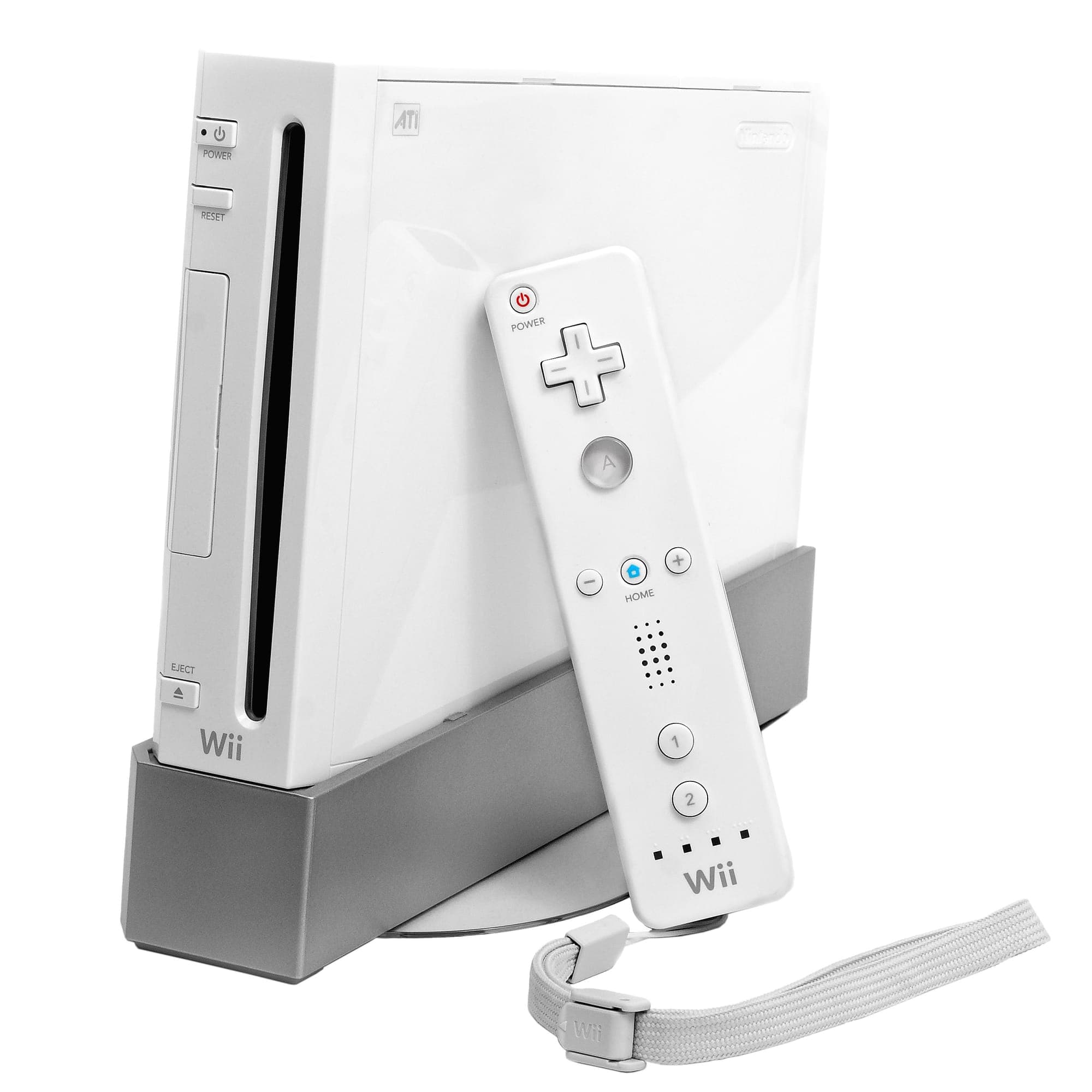
The Wii is everywhere, so what's actually rare?
Somewhere in a drawer near you, a white Wii is resting under a tangle of cables, its sensor bar wrapped around a remote with a slightly chewed silicone jacket. Nintendo shipped over 100 million of these things, and it sometimes feels like half of them were donated, boot-saled or handed to a nephew before 2013 was out. That glut is exactly what makes the Wii interesting to collect: the hardware is nearly free, so all the collector attention concentrates in the stuff that isn't.
Flip it over first: why RVL-001 is the only Wii worth chasing
The launch-era RVL-001 is secretly two consoles. Pop the flaps on top and you'll find four GameCube controller ports and two memory card slots – it plays GameCube discs natively. For anyone building a Nintendo shelf, that turns a cheap white box into one of the most practical machines the company ever made.
The 2011 RVL-101 "Family Edition" quietly deleted all of that: no flaps, no ports, no GameCube playback, and it's designed to lie horizontally. Then came the RVL-201 Wii Mini – a red-and-black top-loader launched first in Canada, with no internet, no SD slot and no GameCube support. The funny thing about cost-cut revisions is that nobody wanted them at the time, so the Mini is now the scarcer sight boxed in many regions. Buy the RVL-001 to actually use; note the Mini exists if you're a completist with shelf space.
Late-run discs are where the money actually hides
By the Wii's final years the shops had moved on, print runs shrank, and that's precisely where values climbed. The Operation Rainfall trio is the textbook case: Xenoblade Chronicles (Monolith Soft), The Last Story (Hironobu Sakaguchi's Mistwalker) and Pandora's Tower all landed late in the console's life, after a fan campaign demanded their western releases – and the NTSC-U Xenoblade was largely a GameStop affair. Complete copies of all three trade well above the Wii's bargain-bin reputation.
Other reliable targets: the steelbook Metroid Prime Trilogy, Fire Emblem: Radiant Dawn, and the Skyward Sword limited edition with its gold Wii Remote Plus. Meanwhile Wii Sports and Mario Kart Wii sold in numbers that guarantee they'll never be rare – loose, anyway. Sealed is a different conversation: even a common party title like Wii Party gets interesting the moment its shrink wrap has survived this many Christmases.
The completeness checklist most listings quietly fail
"Boxed" is doing a lot of work in the average Wii listing. Run the checks:
- Sensor bar (RVL-014): wired, fragile and eternally lost. A "complete" console without one isn't – and while any infrared source technically works in a pinch, good luck explaining the candles.
- Wrist straps: launch remotes shipped with a thin strap; after that first winter of remotes going through television screens, Nintendo issued a thicker strap with a sturdier clasp and, from 2007, the silicone Remote Jacket. Strap type is a quick authenticity tell on any "launch condition" console.
- Inner trays and inserts: the cardboard tray, manual stack, paper inserts, plus the stand and round stabiliser plate the vertical RVL-001 shipped with. These vanish first and are nearly impossible to source honestly later.
- The Wii Sports variant trap: pack-in copies often came in a cardboard sleeve, not a retail keep case. A sleeve disc dropped into a standard case isn't wrong, but it isn't original either – a proper retail Wii Sports is its own distinct item.
The oddball peripherals nobody thought to keep
The Wii's accessory ecosystem was gloriously unhinged, and because it all read as plastic tat at the time, boxed examples are often scarcer than the games. The Wii Zapper shell came bundled with Link's Crossbow Training – one of the few Zelda-branded releases you can still pick up cheap. The Balance Board arrived with Wii Fit and mostly retired as a bathroom scale; finding one boxed with the game and manuals is harder than it has any right to be.
Add the Wii Wheel, the Classic Controller Pro, and the MotionPlus dongle with its extended rubber sleeve – that sleeve alone is a small completeness landmine, because everyone binned it on day one. This is the fun tier of Wii collecting: nothing costs much yet, and almost none of it survived intact.
So here's the honest takeaway: the Wii is the cheapest time machine in console collecting, and the hard part was never finding one – it's finding one nobody touched. Skip the tenth loose console and put your money into straps, sleeves, trays and late-run discs instead. And tell us: which Wii piece in your collection would you never sell?


