 Back
Back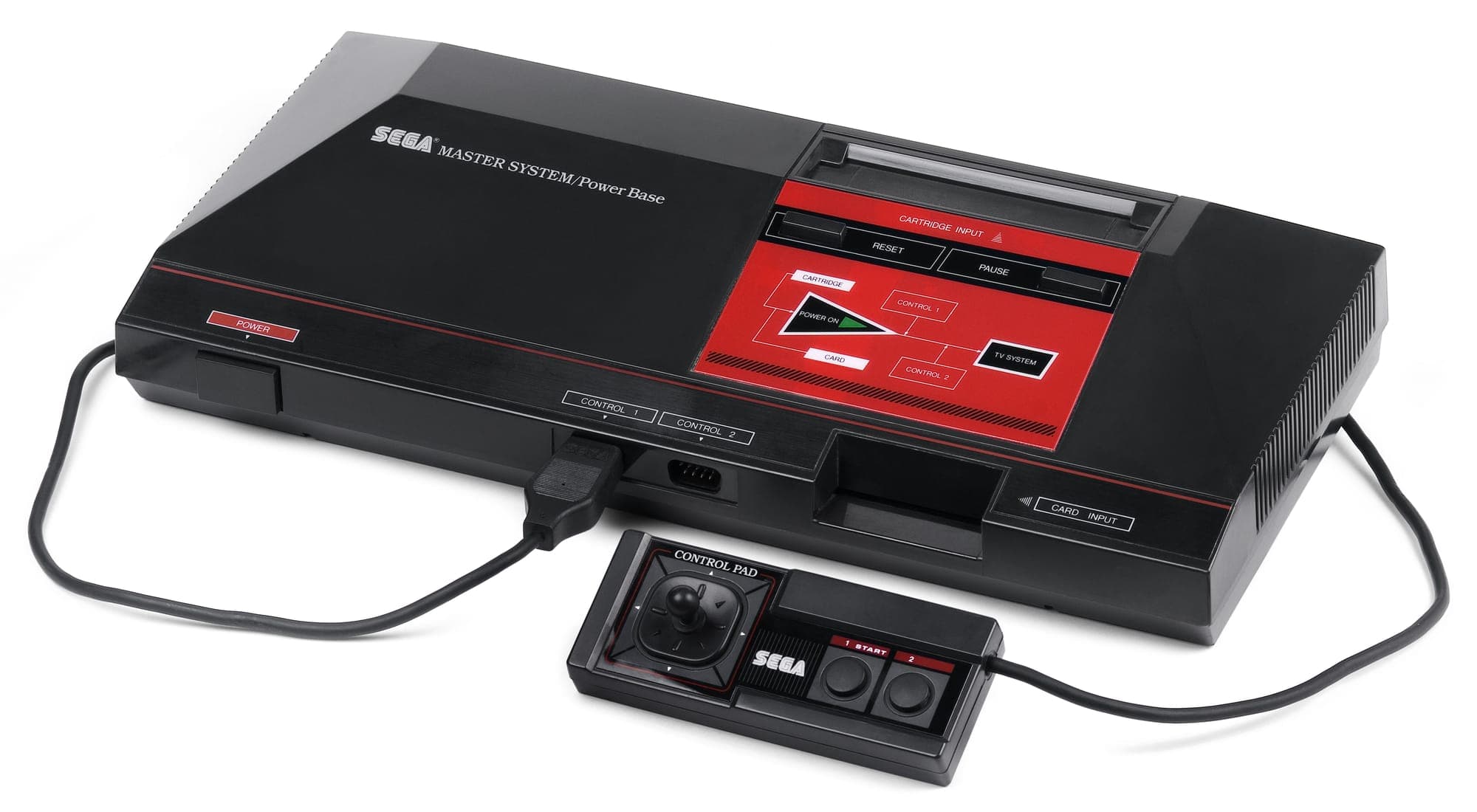
Why the Sega Master System Still Rewards Patient Collectors
Switch on an early Master System with no cartridge in the slot, hold Up and both buttons, and Snail Maze appears – a complete little game Sega tucked into the console's BIOS. That's the Master System in a single gesture: generous, slightly odd, and hiding more than it lets on. Most of the world never noticed, because most of the world was busy with the NES.
Most of the world, that is, except Europe and Brazil. Which is exactly why the Master System remains one of the most satisfying 8-bit libraries you can still hunt without remortgaging anything.
The console war Europe watched from the other side
The machine started life in Japan as the Sega Mark III in 1985, got a black-and-red redesign, and reached Europe in 1987, pushed hard by distributor Mastertronic. While Nintendo locked up Japan and North America, the Master System won real territory across Europe – and in Brazil, Tectoy kept the platform alive for decades after everyone else had moved on.
That history shapes the hunt today. PAL is the Master System's natural habitat, and the late European releases prove it: Asterix, Master of Darkness, and the genuinely excellent 8-bit Sonic the Hedgehog all exist because the console kept selling here long after it faded elsewhere. Sega's bond with Europe ran deep – a decade later it was a British studio, Bizarre Creations, building Metropolis Street Racer for the Dreamcast.
Then there's the shelf presence. Western Master System boxes are ruled like graph paper – a stark grid, one small square of artwork, and a stripe announcing whether you're holding a Sega Card, a Mega Cartridge, or a Two-Mega Cartridge. Lined up on a shelf, nothing else from the era looks so deliberate.
Model 1 or Model 2 – let the card slot decide
The original Model 1 is the collector's machine. It has both a cartridge slot and a card slot, an expansion port, and a pause button on the console itself – a quirk every Master System owner's thumb remembers. Early units carry Snail Maze in the BIOS, and some shipped with Hang-On built in.
That card slot matters more than it looks, too: Sega's SegaScope 3-D glasses connect through it, so the whole 3-D catalogue is Model 1-only territory.
The Master System II is the cost-cut. No card slot, no expansion port, a rounded shell, and Alex Kidd in Miracle World built in – later European units swapped in Sonic. It's a lovely, cheap way to play, and half of Europe grew up on exactly this unit, but it locks you out of cards and 3-D. Buy one as a player, not as the centrepiece.
Sega Cards and other beautiful oddities
Before cartridges got cheap, Sega sold games on credit-card-sized Sega Cards – small-capacity early releases like Ghost House, F-16 Fighter, Spy vs Spy and My Hero. They're the platform's cult format: easy to overlook in a shop's junk drawer, easy to lose, and quietly tricky to find complete with case and manual. If you enjoy hunting the overlooked, cards are your event.
The cartridge library, meanwhile, has far more personality than its reputation suggests:
- Phantasy Star (1987) – one of the earliest great console RPGs, with animated first-person dungeons the NES had no answer to;
- Wonder Boy III: The Dragon's Trap (Westone, 1989) – an early metroidvania so good it earned a loving modern remake;
- the Master System port of R-Type – a shockingly capable 8-bit conversion of an arcade monster;
- Psycho Fox and Fantasy Zone – pure, weird, sun-bright Sega.
What honest condition looks like after four decades
Master System games came in plastic clamshell cases, which sounds durable until you meet forty-year-old plastic. Check the hinges first – they crack and shed teeth long before anything else fails. Then hold the case to the light: sun-fade drains the artwork and turns those crisp white grids a tired cream, and a faded spine is obvious from across the room once you know to look for it.
Manuals walk. These games were played hard and lent around whole neighbourhoods, so a case with its manual genuinely intact is the quiet premium here. On consoles, expect yellowed shells – the plastic ambers with UV exposure – and be sceptical of suspiciously white units, which may have been aggressively retrobrighted. Test the pause button on a Model 1; it's on the console, and it's had decades of thumbs.
Here's what makes the platform special: none of this requires deep pockets, just patience. The common library still turns up wherever flea markets and car boot sales exist, so the game isn't acquisition – it's condition. Anyone can amass a stack of Master System games. Building a shelf of unfaded grids with intact hinges and manuals present takes years, and costs mostly attention.
The NES gets the documentaries. The Master System gets something better: a library you can still do justice to by being sharp-eyed rather than rich. So – Model 1 with the card slot, or is the II's built-in Alex Kidd the truer European memory?


