 Back
Back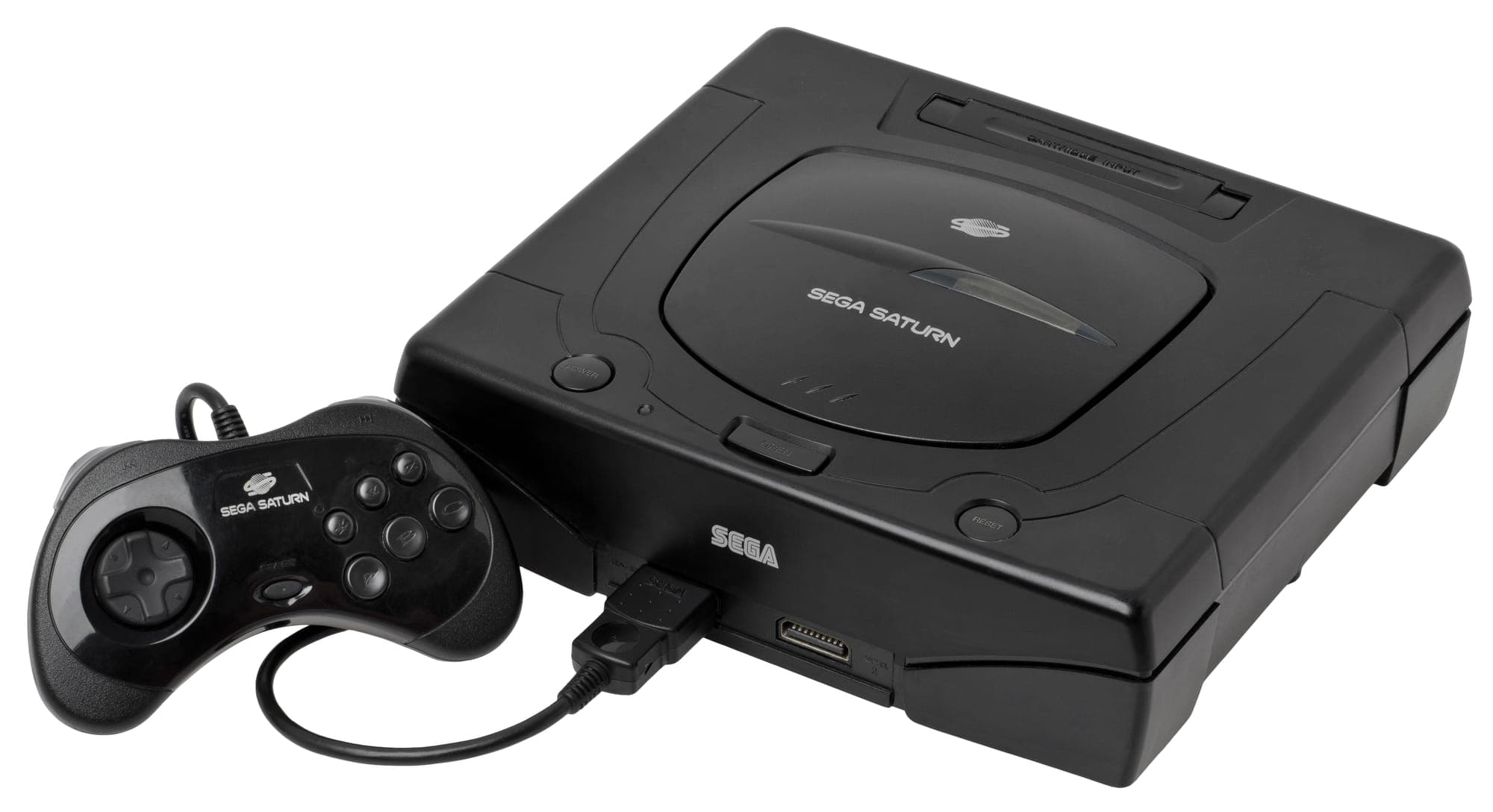
Why the Sega Saturn Is the 32-Bit Era’s Great Underdog
Tom Kalinske walked onto the stage at the very first E3 in May 1995 and told the room the Sega Saturn wasn’t launching in September as planned – it was launching right now, at $399, in stores that same day. Minutes later, Sony’s Steve Race stepped up to the podium, said “$299”, and walked off. That’s the entire 32-bit console war compressed into about ninety seconds.
The surprise launch that torched Sega’s own shelves
The plan had been “Saturnday”, September 2, 1995. Instead, Sega rushed early units to a handful of chains – Toys “R” Us and Electronics Boutique among them – and blindsided everyone else. Retailers cut out of the launch, KB Toys most famously, were furious, and some simply stopped stocking Sega hardware altogether.
Worse, there was barely anything to play. The rushed date meant a thin launch lineup, and third parties who’d been building toward September suddenly had a console on shelves with no software pipeline behind it. In Japan, where the Saturn had launched in November 1994 with Virtua Fighter flying off shelves beside it, the machine genuinely traded blows with the PlayStation for a while. In the West, it never recovered from its own opening move.
Two CPUs, eight processors, one quad-shaped headache
The Saturn’s spec sheet reads like a committee argument. Two Hitachi SH-2 CPUs at 28.6 MHz. Two video processors – VDP1 drawing sprites and textured polygons, VDP2 handling backgrounds. A Motorola 68EC000 running the Yamaha sound hardware, plus a system control unit with its own DSP. Count generously and you reach the “eight processors” figure Sega’s marketing loved.
The catch: almost none of it played nicely together. The second SH-2 shared a bus with the first, so naive code left it idling. And where the PlayStation drew triangles, the Saturn drew quadrilaterals – every cross-platform 3D engine had to be rethought, and transparency effects often shipped as that tell-tale mesh dither. Late-generation ports routinely arrived worse on Saturn, and the machine earned a reputation it only half deserved.
Because when a team actually mastered the thing – AM2, Sonic Team, Treasure – the Saturn sang. Virtua Fighter 2 running in high-resolution mode at a locked 60fps remains one of the great hardware flexes of the era.
The library that makes collectors forgive everything
The Saturn never got a mainline Sonic. Sonic X-treme collapsed in development, leaving Sonic R and the Sonic Jam compilation to hold the fort while the hedgehog’s true peak stayed back on the Genesis with Sonic the Hedgehog 2. What the Saturn got instead was stranger and, honestly, better:
- Panzer Dragoon Saga (1998) – a four-disc RPG with a tiny Western print run, now one of the most expensive discs of its generation.
- NiGHTS into Dreams (1996) – Sonic Team’s flying dream-opera, best experienced with the analogue 3D Control Pad it launched alongside.
- Sega Rally Championship and Virtua Fighter 2 – arcade conversions that embarrassed everything else in the living room.
- Radiant Silvergun – Treasure’s Japan-only shooter and a grail hunt in its own right.
- Guardian Heroes, Dragon Force and Shining Force III – a 2D and strategy catalogue the PlayStation couldn’t match.
In Japan the Saturn doubled as an arcade-perfect 2D powerhouse: Capcom’s X-Men vs. Street Fighter with the 4MB RAM cartridge still runs tag battles the PlayStation port could only dream about.
Model 1 or Model 2 – and what your money buys today
Western Saturns come in two flavours, and the tells are quick. Model 1: oval power and reset buttons, plus an access LED that glows while the disc is read. Model 2: round buttons, no LED, and it shipped with the redesigned Japanese-style pad – still one of the best D-pads ever fitted to a controller. Neither is inherently the better console; internals were revised across both runs, so condition beats badge every time.
Two things to check before any purchase: the CR2032 battery in the back compartment (internal saves die with it – a backup memory cartridge is the proper fix) and the health of the laser. Japanese consoles – grey first run, white later run – are usually the cheapest way in, and an Action Replay-style cartridge deals with the region lock.
The software market splits hard. Japanese imports are plentiful and mostly affordable; low-print Western releases from the console’s final stretch – Panzer Dragoon Saga, Burning Rangers, Magic Knight Rayearth – head the other way fast. PAL collectors get off lightest at the entry level, where common sports titles like NBA Live 98 still turn up boxed for pocket money.
Sega carried every bruise from the Saturn straight into the Dreamcast: developer-friendly hardware, a proper launch date, and games like Metropolis Street Racer that showed what a focused Sega could do. But here’s the hot take: the Saturn owns the strongest exclusive library of any console that lost its generation. Disagree? Fine – but bring your Shining Force III save file to the argument.


