 Back
Back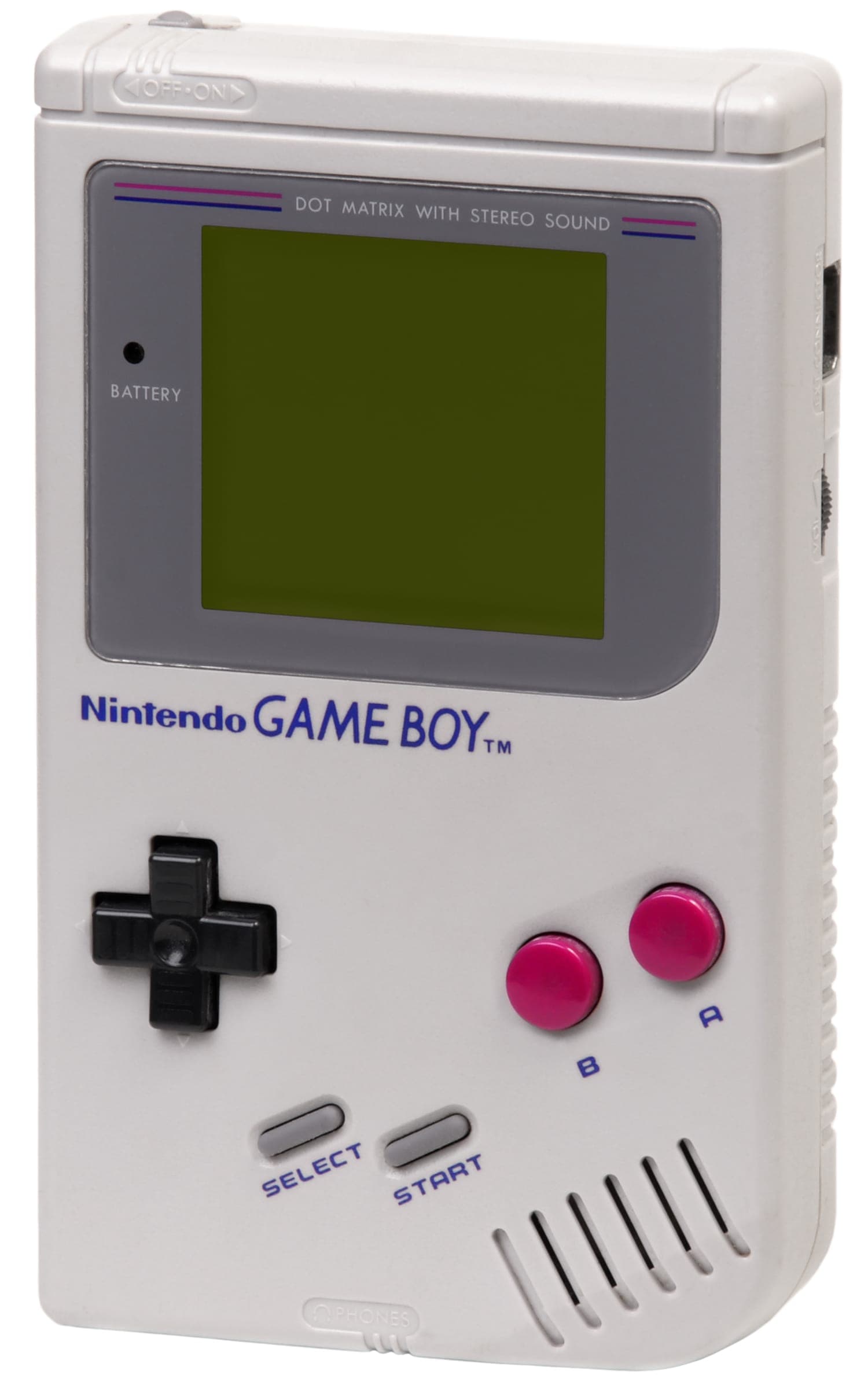
How to buy an original Game Boy without getting a re-shell
Slide the battery cover off before you talk price. On an original Game Boy – the grey DMG-01 brick Nintendo shipped in 1989 – those four AA terminals will tell you more about the machine's last few decades than any glamour shot in the listing.
By spec-sheet logic, the brick should have lost. Its Sharp LR35902 ran at roughly 4.19 MHz and drove a 160×144 screen in four shades of pea-soup green, while Sega's Game Gear and the Atari Lynx offered full-colour, backlit displays. But those rivals devoured batteries in a single sitting; the Game Boy ran for ages on four AAs, came bundled with Tetris in the West, and quietly invented the idea that a whole games library could live in a coat pocket. Portable collecting starts here.
From grey brick to Play It Loud: learn the shell language
The classic line runs like this. The 1989 DMG-01 is the archetype: chunky, matte grey, contrast wheel on the left side. In 1995 Nintendo loosened its tie with the Play It Loud series – the same hardware in red, yellow, green, blue, black and a clear see-through shell that let you watch the board work. Clear shells hide nothing, which is exactly why honest, unyellowed examples are such a satisfying find.
Then came the 1996 Game Boy Pocket (MGB-001): dramatically slimmer, running on two AAAs, with a crisper black-and-white screen that killed most of the ghosting. Collector trivia that matters: the earliest Pockets shipped without a power LED, and Nintendo added one in a later revision – a quick way to date a unit like this black Game Boy Pocket. Japan alone got the 1998 Game Boy Light (MGB-101), the only member of the classic family with a built-in backlight – hold that thought, it matters later. The line kept shrinking all the way to the Game Boy Micro in 2005, but the monochrome machines are where classic Game Boy collecting really lives.
The five-minute ritual before any money moves
Every DMG and Pocket deserves the same inspection, ideally powered on with a cart loaded:
- Screen lines. Sweep the contrast wheel and watch for vertical dark or missing lines – the classic DMG ailment, caused by failing ribbon-cable connections along the edge of the display. Vertical lines are famously repairable with careful heat along that cable; horizontal lines are a much worse sign.
- Battery bay. White or green crust on the terminals means an alkaline leak. Light surface corrosion cleans up; crust that has crept past the springs may have followed the contacts toward the board.
- Sound and wheels. Crackly volume pots and scratchy speakers are common and fixable – treat them as negotiation points, not surprises to discover at home.
- Loose carts too. Check the edge connector for corrosion and the label for lift; a loose cart like this Aladdin Game Boy cart should show clean pins and a label that sits flat.
Why a dead coin cell changes what working means
Classic carts that save your progress – The Legend of Zelda: Link's Awakening, Pokémon Red and Blue, and friends – keep that save alive with a coin cell soldered inside the cartridge. When the cell finally dies, the game still boots and plays perfectly. It just forgets everything the moment you power off.
That's why working is a spectrum on this platform. Pokémon Gold and Silver are the extreme case: their in-game clock draws on the battery constantly, so those cells tend to die sooner than most. The fix is a cheap battery swap, but it means opening the cart – which collides head-on with any claim of a factory-untouched cartridge. So ask every seller one question: does it still hold a save overnight?
The re-shell trap: when a Game Boy looks too good
Here's where the Game Boy Light detail pays off. No DMG, no Play It Loud shell, and no Pocket ever shipped with a lit screen. If a classic Game Boy glows – bright, vivid, playable in a dark room – it's carrying a modern IPS display mod. That's a lovely upgrade for playing, and a serious problem when it's priced and described as an unrestored original.
Reproduction shells are the quieter half of the trap. Nintendo fastened these machines with tri-point screws, so Phillips heads mean someone has been inside. Check that the serial sticker on the back exists and wears like the rest of the unit, and trust your fingertips: aged original plastic has a softly worn, matte feel, while fresh repro shells look uniformly crisp, with suspiciously sharp lettering around the lens. A handheld from 1989 in better cosmetic shape than your phone deserves questions, not applause.
None of this makes modded units the villain – an IPS-modded, re-shelled DMG is honestly the nicest way to play Game Boy today. The sin isn't restoration; it's omission. Buy the tired survivor or buy the gorgeous rebuild, but make sure the price and the description agree on which one it is. And the hot take, free of charge: the battle-scarred, all-original brick with a clean battery bay is the one your collection will still be proud of in twenty years. Boring grey wins again.


