 Back
Back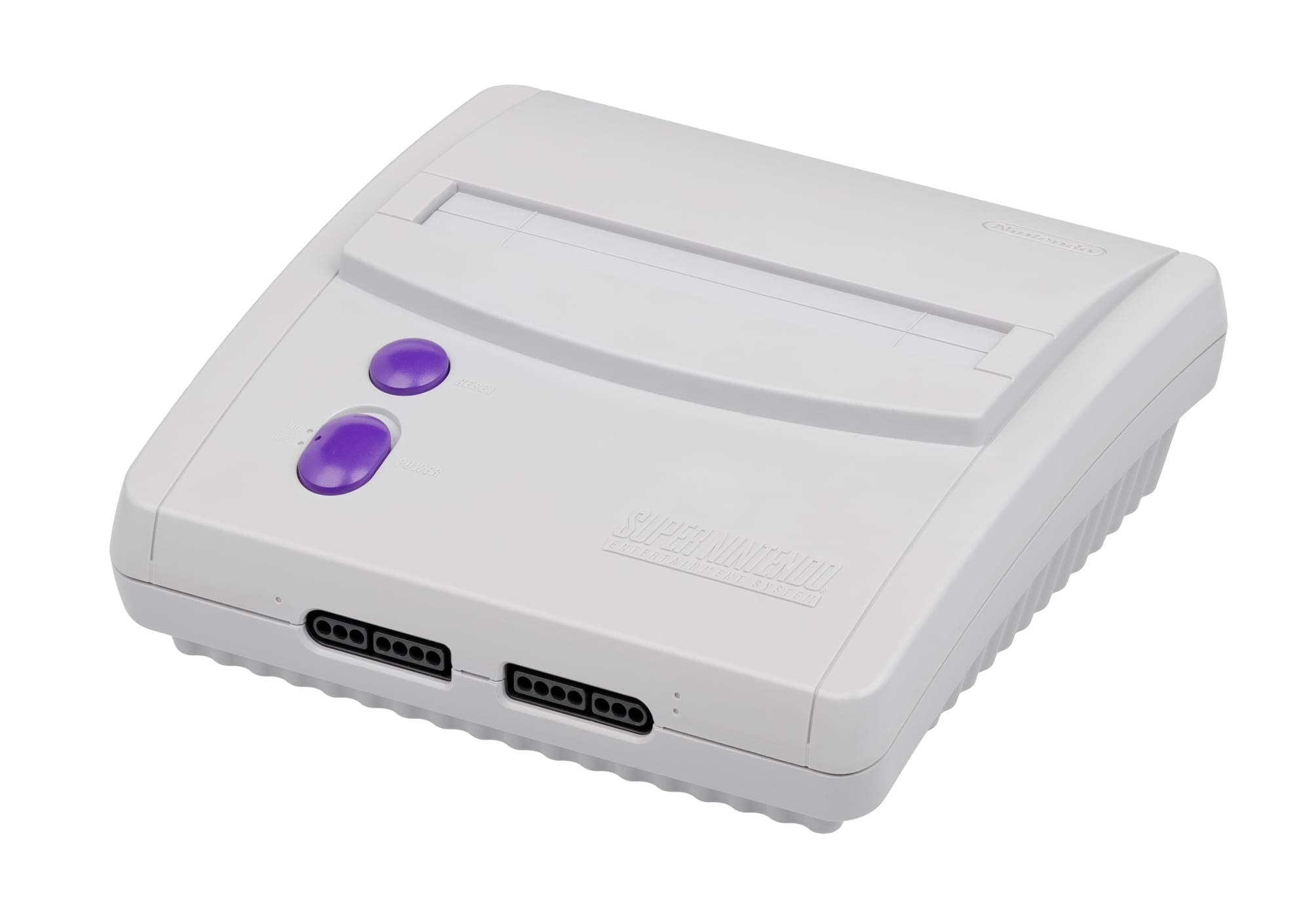
Why SNES Shell Yellowing Is the Honest Collector's Test
Flip over the next SNES you find at a flea market. Odds are the top shell and the bottom shell are two different colours – one drifting toward old margarine, the other still close to Nintendo's original grey. That mismatch isn't grime, and it isn't just sun damage. It's chemistry, and it's the most useful thing to understand before you buy, sell, or restore Super Nintendo hardware.
Why one console yellows in two different shades
The SNES shell is ABS plastic mixed with brominated flame retardants – sensible fire-safety engineering at the time, a slow-motion cosmetic disaster ever since. Expose that plastic to UV light and heat and the bromine compounds degrade, shifting the surface from grey toward yellow and, in bad cases, full nicotine-brown.
Nintendo didn't pour the whole console from one batch. Top and bottom halves often came from different plastic formulations, which is why so many North American SNS-001 units age unevenly – a yellowed deck sitting on a greyer base, while the purple power and reset sliders stay stubbornly vivid. Those purple parts are a different plastic entirely, and they make the yellowing look even worse by contrast.
Storage slows the process but doesn't stop it. A console boxed in a dark cupboard yellows more slowly than one that lived under a sunny window, but heat and oxygen do quiet work of their own. So if a loose console turns up looking impossibly white, look closer – you're probably admiring restoration, not luck.
Retrobright divides collectors for a reason
The standard fix is retrobrighting: hydrogen peroxide plus UV exposure, which reverses the discolouration and can make a tired flea-market console look showroom-fresh in an afternoon. The results are genuinely impressive. So why do some collectors treat the word like a slur?
- It can come back. Retrobrighted plastic often re-yellows over time, sometimes unevenly, leaving blotches worse than the original patina.
- It can scar. Careless application causes streaking and marbling that no second treatment fully undoes.
- It rewrites history. A treated console presented as "minty, always stored in the box" is a lie with a chemical assist.
The honest position: retrobright is fine for a player's console, controversial for a collector's piece, and unforgivable when undisclosed. If you're selling, put "retrobrighted" or "original patina" in the listing and photograph the top and bottom shells separately, in daylight. And if you want plastic that has genuinely never seen the sun, that's what graded, factory-sealed examples are for – there you're paying for certainty, not shine.
Three consoles wearing the same name
"Super Nintendo" is really three machines. Japan got the Super Famicom in November 1990 – rounded shell, four coloured face buttons. North America got the boxy, purple-accented SNES in August 1991, restyled by Nintendo designer Lance Barr. PAL territories got the Super Famicom's curves in 1992 under the SNES name, running at 50Hz – which meant plenty of unoptimised games played noticeably slower and letterboxed compared to their NTSC versions.
The split runs deeper than the shell. Japanese and PAL carts share the rounded shape; North American carts are squared-off, and a CIC lockout chip polices region on top of the physical difference. Even the names diverge: Europe's copy of Nintendo and Argonaut's Super FX showcase shipped as Starwing, not Star Fox, thanks to a trademark clash. For collectors that's a feature, not a bug – a PAL Starwing and an NTSC Star Fox are two different artefacts of the same game, and serious SNES shelves usually end up deliberately cross-region.
The battery clock ticking inside your favourite carts
Most SNES games that save – A Link to the Past, Super Metroid, Super Mario World – hold progress in battery-backed SRAM, typically fed by a CR2032 cell soldered to the board. Those cells are now several decades old. When one dies, the game plays fine but forgets everything the moment you power off.
A battery swap is a simple solder job, and it doesn't split opinion the way retrobright does – but the same disclosure rule applies. A good listing says "saves tested and holding" or "battery untested," never just "works great." Some carts dodge the issue entirely: Star Fox never saved anything, so there's no battery to die.
The other pressure on the cart library is reproduction. EarthBound, Chrono Trigger and the rest of the most-wanted tier get faked constantly, and modern repros can fool a photo. Your defences:
- Check for Nintendo's 3.8mm security screws – Phillips heads on the shell are a red flag.
- Peek at the circuit board through the cart's top seam; genuine Nintendo PCBs look nothing like a repro's flash board.
- Compare label gloss and print sharpness against a cart you know is real.
If a seller won't show the board, that tells you plenty.
Here's the thing that makes the SNES special to collect: its condition is legible. The plastic records light, the battery records time, the screws record tampering. Buy accordingly – and when you list, let the plastic tell its own story. An honestly described banana-yellow console will always find a better home than a suspiciously white one. So, where do you stand: original patina or peroxide?


